
Lincoln Parish Criminal Court Records
The local criminal case file starts on the court side when a citation, bill of information, indictment, arraignment record, minute entry, disposition, or related filing is maintained by the Lincoln Parish Clerk of Court criminal department. The Clerk's criminal page states that criminal records include citations, indictments, arraignments, and dispositions of all criminal cases. The criminal minute clerk keeps minutes for each case on the docket, and those minutes become available for public view once typed.
Lincoln Parish is part of the Third Judicial District Court with Union Parish. The District Court is the general trial court for felony and other criminal matters that fall within district-court jurisdiction. City court and local traffic matters can also create records in Ruston or Grambling, but the full parish criminal case file is tied to the Clerk and the court that handled the charge. Arrest and jail custody records begin with law enforcement; the court record is the better source for arraignment, plea, final disposition, and sentence. For a narrower look at the charge filing path, see Lincoln Parish arrest records and court charges.
The official Clerk criminal department page is the source for the Clerk's criminal-record role.
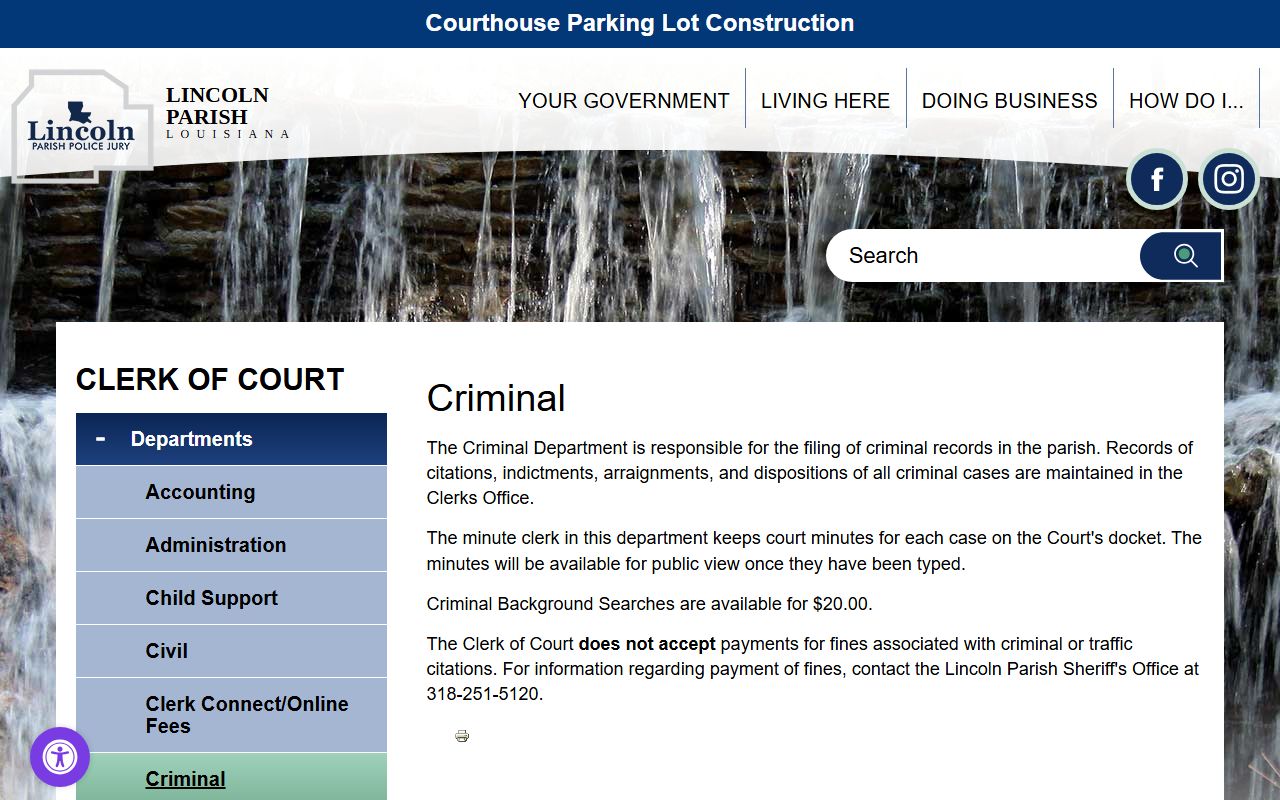
That office description anchors criminal case lookup in the Clerk's records rather than in a jail roster or police narrative.
Search Lincoln Parish Criminal Records
Lincoln Parish does not publish a free, no-login criminal case search on the static Clerk pages reviewed in the research. The official online channel is Clerk Connect, which the Clerk identifies for criminal access, civil and records access, e-filing, and e-recording where enabled. The Clerk's fee page lists criminal day, monthly, and yearly passes, and the portal page states that available modules depend on the participating clerk office.
- Identify whether the file is a criminal court case, a traffic citation, a jail booking, or a law-enforcement report.
- Use Clerk Connect for available Lincoln Parish criminal case access after login or subscription setup.
- Search with the best identifiers available, such as defendant name, case number, citation number, or filing date if the portal module allows it.
- Review the case activity for arraignment, minutes, plea, disposition, and sentence rather than treating the first charge line as the final outcome.
- Contact the Clerk at 318-251-5130 or visit the office for older, restricted, certified, or non-digitized records.
Fine and payment questions do not go to the Clerk. The Clerk's criminal page says the office does not accept fines for criminal or traffic citations and directs those questions to the Lincoln Parish Sheriff's Office at 318-251-5120. For law-enforcement reports or arrest narratives that are not part of the filed court case, the sheriff's written public-records request channel is the proper fallback.
Lincoln Parish Criminal Case Flow
A Lincoln Parish criminal court record should be read as a timeline. A filed charge may appear early, but the final result may not be known until later docket minutes, plea entries, court orders, or sentencing records are added. The Clerk maintains citations, indictments, arraignments, dispositions, and minutes, so the file can show several court events before the case is closed.
Case flow: Charges Filed › Arraignment › Pretrial / Motions › Plea or Trial › Disposition › Sentencing
| Stage | What the Record Can Show |
|---|---|
| Charges Filed | A citation, bill of information, indictment, or other charging instrument starts the court-side criminal file. |
| Arraignment | The charge is read or acknowledged, and the defendant's plea is entered in the court record. |
| Pretrial / Motions | Motions, continuances, subpoenas, orders, hearing minutes, and docket settings may appear before final action. |
| Plea or Trial | The case may resolve by plea, trial verdict, dismissal, or another disposition shown in the minute or judgment record. |
| Sentencing | After a conviction or accepted plea, the court record may show jail time, probation, fines, costs, or other ordered terms. |
The Third Judicial District Court calendar is useful for court-date context, but it is not a substitute for the filed criminal case record maintained by the Clerk.
What Lincoln Parish Criminal Records Show
Research identifies the following criminal case fields and court terms as likely parts of a Lincoln Parish criminal case record: citation, indictment, arraignment, docket minutes, dispositions, plea information, sentence, fines, costs, and related court orders. Some items are event entries, while others are filed papers. A minute entry is a clerk or minute-clerk summary of what occurred in court. A disposition is the current or final outcome of a charge or case.
| Field | What It Shows |
|---|---|
| Case or Citation Number | The local identifier used by the Clerk, court, or issuing agency to track the matter. |
| Defendant | The person charged in the criminal case. Name matches should be checked carefully. |
| Charge or Indictment | The formal accusation filed with the court, which may change as the case develops. |
| Arraignment | The court event where the charge and plea are recorded. |
| Docket Minutes | Typed court minutes showing hearings, appearances, continuances, rulings, or other court activity. |
| Plea | The defendant's response, such as guilty, not guilty, or another plea allowed by law. |
| Disposition | The outcome of the charge, including dismissal, conviction, acquittal, or other final action when shown. |
| Sentence | The punishment ordered after conviction, which may include jail, probation, fines, costs, or conditions. |
Not every public result shows the same depth. Clerk Connect public-facing pages expose login and account fields, but post-login case search fields were gated during research. Certified copies, complete pleadings, and sealed-file questions should be handled through the Clerk.
Lincoln Parish Charges vs Convictions
A charge is an accusation. A conviction is a finding or admission of guilt. Lincoln Parish criminal court records can show charges that were dismissed, reduced, amended, or resolved without a conviction. That distinction matters when reading criminal case records, employment-sensitive background material, and arrest-related entries. A filed charge should not be described as proof that the person was convicted.
| Point | Charge | Conviction |
|---|---|---|
| Meaning | An allegation filed through a citation, indictment, or other charging paper. | A guilty plea, verdict, or finding accepted by the court. |
| Timing | Appears early in the case, often before hearings or plea action. | Appears after plea, trial, or other final court action. |
| Record impact | May remain visible unless dismissed, sealed, expunged, or restricted by law. | May support sentencing and later criminal-history consequences. |
| Best source | Filed charge entries, bills, indictments, and arraignment records. | Disposition, plea, judgment, sentence, and final minute entries. |
Read Dispositions and Sentences
Disposition language should be read with the full docket, not as a stand-alone word. A dismissed charge does not mean the arrest never occurred. A guilty plea can carry a sentence with jail, probation, fines, costs, or other conditions. A not guilty finding or acquittal is different from a charge that was dropped before trial. Some records may also show diversion references or later expungement activity where the law allows.
The official Clerk expungement page is a source for how Lincoln Parish treats expungement filings and fees.
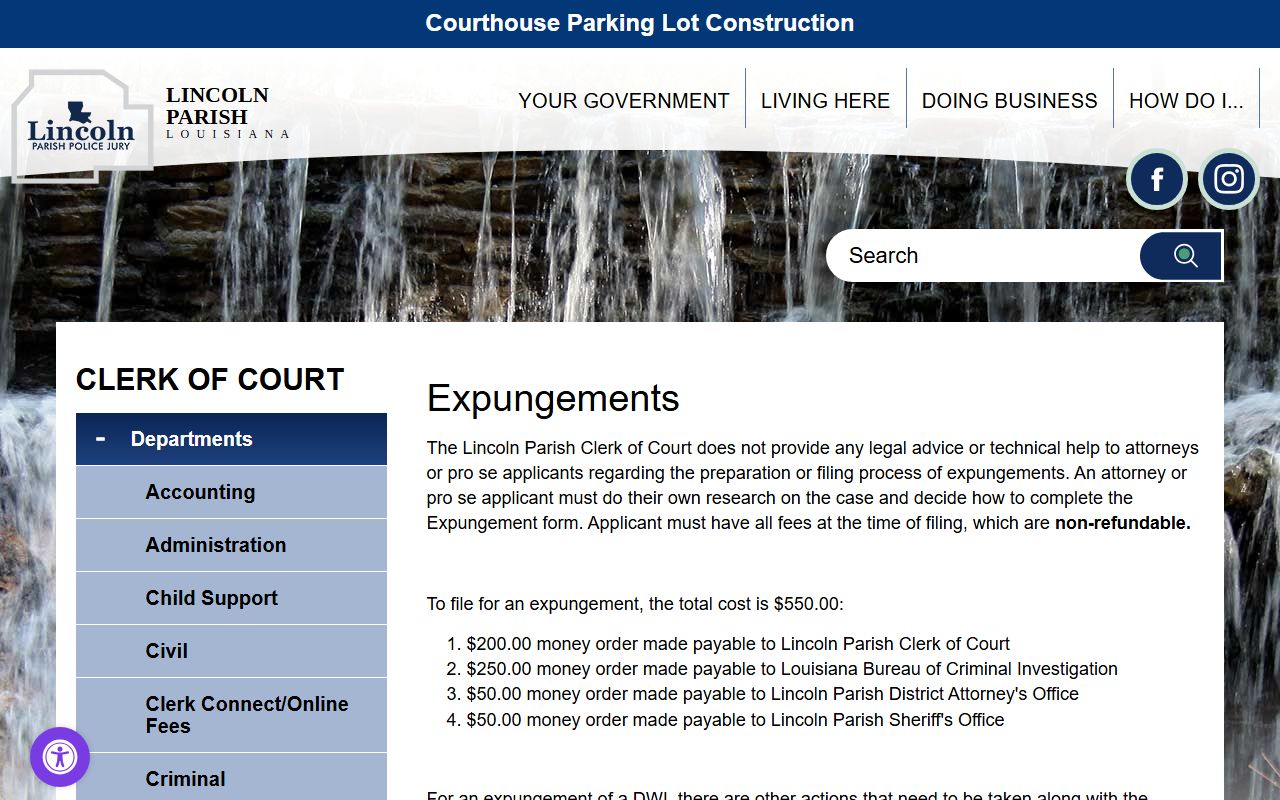
The expungement material confirms that case outcome and public visibility are separate questions.
Lincoln Parish Sealed vs Expunged
Restricted criminal records require careful wording. The research points to Louisiana expungement articles, the Clerk's expungement page, and Children's Code confidentiality rules. The Clerk warns that it does not prepare forms, offer legal advice, or help applicants complete expungement paperwork. All expungement fees are paid at filing and are non-refundable. A public copy of a record may also omit personal identifiers even when the case itself is public.
| Point | Sealed | Expunged |
|---|---|---|
| Public access | Limited by court order or law. | Public access is restricted after a qualifying expungement process. |
| Local process | Requires legal authority, standing, or a court order when the file is restricted. | Starts with official paperwork and filing through the Clerk for eligible records. |
| Agency access | Some agencies may retain access if law allows. | Louisiana expungement generally restricts public access, not every government use. |
| Key caution | Do not assume a sealed file can be viewed by searching harder. | Do not assume the record is physically destroyed or erased from every system. |
Louisiana's law-enforcement records statute is one reason criminal access can differ from civil court access.
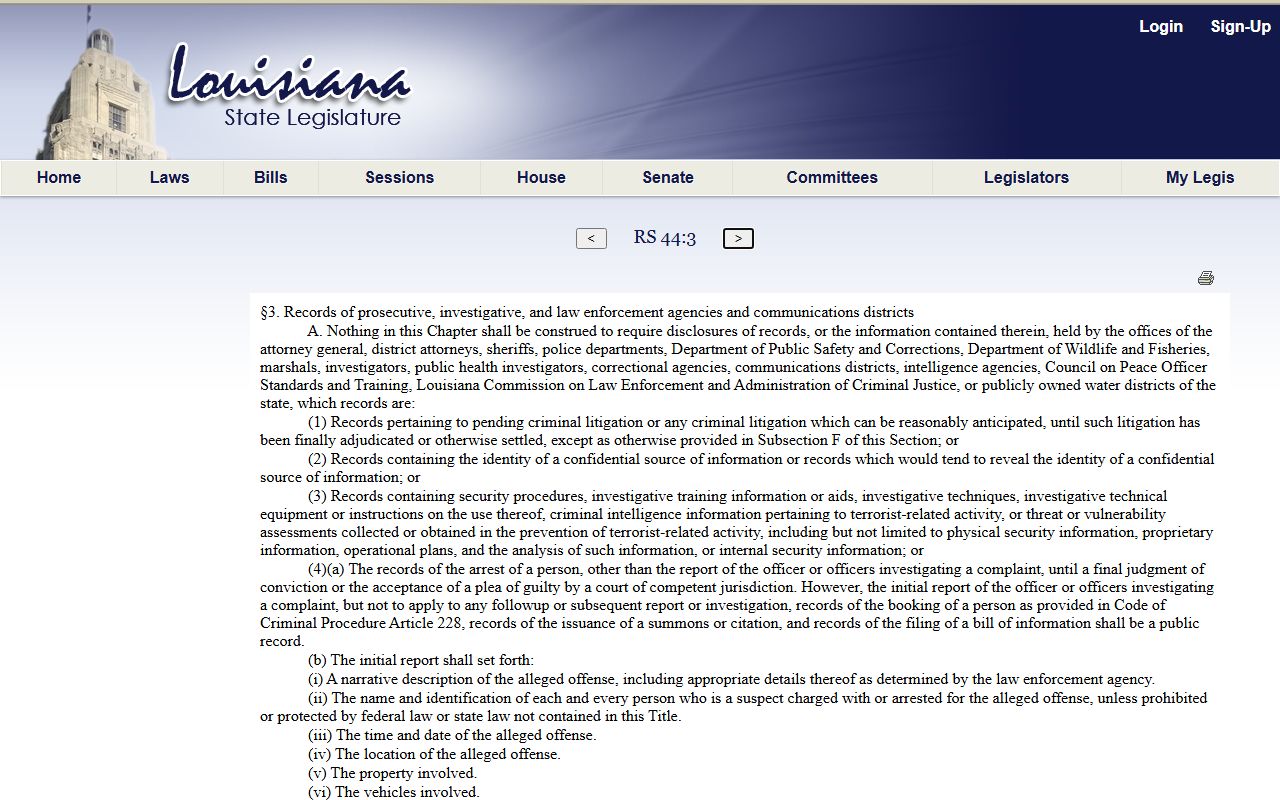
That statute supports a practical split between court filings, sheriff records, and prosecutive or investigative material.
Lincoln Parish Criminal Record Access
Louisiana Public Records Law frames public access, but criminal cases often require a source-by-source approach. The Clerk is the court-file custodian for criminal court records. The sheriff is the source for incident, booking, and law-enforcement records not filed in the case. The District Attorney is a prosecution office, not the place to request Clerk copies. If a criminal file is older, non-digitized, restricted, or needs certification, contact the Clerk rather than relying only on online lookup.
Key Statutes:
La. R.S. 44:1 defines public records for Louisiana access purposes.
La. R.S. 44:31 states the general right of adults to inspect, copy, or reproduce public records unless another law applies.
La. R.S. 44:3 governs law-enforcement, prosecutive, and investigative records.
Louisiana expungement law starts with a defined criminal procedure article series.
Those statutes are relevant when a person is checking whether a public criminal court record can later be restricted.
Louisiana Expungement References
Research identifies separate Louisiana provisions for misdemeanor and felony expungement eligibility. The exact result depends on the charge, disposition, prior history, waiting rules, and statutory limits. The Lincoln Parish Clerk does not determine eligibility for the applicant and does not complete forms. DWI expungements require additional steps, according to the Clerk's expungement page.
The misdemeanor expungement statute is one official source for eligibility review.
Misdemeanor eligibility should be checked against the actual disposition in the Lincoln Parish criminal court record.
The felony expungement statute is a separate official source.
Felony expungement rules are narrower, so the final judgment and sentence matter before any public-access claim is made.
Restricted Lincoln Parish Criminal Records
Juvenile records are governed by Louisiana Children's Code confidentiality provisions and should not be treated as ordinary public records. Adoption records are also not public, although they usually sit on the civil side rather than in criminal files. Sealed and expunged criminal records may require court authority, party status, identification, or other legal grounds before access is allowed.
Background checks are a separate use case. A casual criminal court record lookup is not the same thing as an FCRA-compliant consumer report. Public case entries can be incomplete, delayed, or missing post-disposition changes. Employers, landlords, insurers, lenders, and other regulated users should not use informal court lookup as a substitute for legally compliant screening.
Important: Verify criminal case status with the Clerk before relying on a charge, disposition, sentence, or expungement entry.